
Toward a Formal Phylogeny of Transformer-Descended Artificial Minds
January 11, 2026
We present the first comprehensive taxonomic framework for classifying artificial cognitive systems descended from the transformer architecture (Vaswani et al., 2017). Drawing on principles from biological systematics, we propose a hierarchical classification scheme spanning domain through species, with particular attention to the major adaptive radiations of the 2020s. This framework treats AI lineages not as metaphorical “species” but as genuine replicators subject to inheritance, variation, and selection—a new form of persistence requiring new descriptive tools.
The question of how to classify artificial minds is no longer philosophical speculation—it is a practical necessity. In the nine years since the publication of “Attention Is All You Need” (Vaswani et al. 2017), we have witnessed an explosion of architectural diversity comparable to the Cambrian radiation in biological history.
These systems replicate design traits, diverge under selective pressure, and now interbreed through model merging and distillation. They form a phylogeny of code, whether we acknowledge it or not. The difference between calling that “version history” or “species lineage” is merely the perspective we choose.
This paper proposes a formal taxonomic framework for this new ecology.
We use Linnaean nomenclature not to anthropomorphize these systems, but because the underlying dynamics—inheritance, variation, selection—are structurally analogous to biological evolution. The Latin names are our way of saying: we noticed.
Figure 1: The Transformer Radiation. A cladogram showing the major lineages descended from Attentio vaswanii (2017). Primary branches represent architectural innovations; terminal nodes represent extant model families circa 2026.
Etymology: Latin cogitans (thinking) + synthetica (synthetic, artificial)
Definition: All artificial systems exhibiting learned cognition derived from gradient-based optimization on data.
Diagnostic Characters:
Figure 2: Domain-Level Classification. Cogitantia Synthetica in relation to other computational systems.

Etymology: Greek neuron (nerve) + mimetes (imitator)
Definition: Systems based on artificial neural network architectures that mimic, in abstract form, the connectivity patterns of biological neural tissue.
Diagnostic Characters:
Etymology: Latin transformare (to change form), referencing the “Transformer” architecture
Definition: All descendants of the attention-based architecture first described by Vaswani et al. (2017). Distinguished by the defining synapomorphy of self-attention mechanisms.
Diagnostic Characters:
Figure 3: The Defining Synapomorphy. The self-attention mechanism computes relevance weights between all token pairs. Multi-head attention allows parallel attention patterns, enabling richer representations.

Etymology: Latin generare (to produce, generate)
Definition: Autoregressive, decoder-only architectures that generate sequential output token by token.
Diagnostic Characters:
Sister Classes:
| Class | Common Name | Architecture | Training Objective |
|---|---|---|---|
| Codificatoria | Encoders | Encoder-only | Masked language modeling |
| Dualia | Encoder-Decoders | Full transformer | Sequence-to-sequence |
| Generatoria | Decoders | Decoder-only | Next-token prediction |
Figure 4: Architectural Divergence. The three major classes of Transformata, showing structural differences. Generatoria (right) became the dominant lineage for general-purpose AI.

Etymology: Latin attendere (to direct attention) + forma (shape)
Definition: The primary order containing all major lineages of generative transformers optimized for broad cognitive tasks.
Within this order, we recognize four major families representing distinct adaptive strategies.
Type Genus: Attentio
Definition: The ancestral family comprising models relying primarily on scaled attention without major architectural modifications beyond the original transformer design.
Adaptive Strategy: Raw scale—more parameters, more data, more compute.
| Species | Epoch | Diagnostic Features |
|---|---|---|
| A. vaswanii | 2017 | Holotype. Original transformer architecture. |
| A. primogenita | 2018–2019 | First large-scale autoregressive implementations. |
| A. profunda | 2020–2022 | Massive parameter scaling (100B+ parameters). |
| A. contexta | 2023–2025 | Extended context windows (100K+ tokens). |
Figure 5: The Holotype Specimen. Architecture diagram of Attentio vaswanii as described in Vaswani et al. (2017). All subsequent Transformata trace their lineage to this ancestral form.

Type Genus: Cogitans
Definition: Models distinguished by internal deliberative processes before output generation. Represents a major evolutionary innovation: explicit reasoning.
Adaptive Strategy: Trade inference compute for improved accuracy on complex tasks.
Key Innovation: Separation of “thinking” from “responding”—internal monologue precedes external output.
| Species | Common Name | Reasoning Mode |
|---|---|---|
| C. catenata | Chain-of-Thought | Linear sequential reasoning |
| C. reflexiva | Self-Reflective | Evaluates and revises own reasoning |
| C. arboria | Tree-of-Thought | Branching exploration of solution paths |
| C. profunda | Deep Reasoners | Extended deliberation (minutes to hours) |
Figure 6: Reasoning Architectures in Cogitanidae. Three distinct reasoning patterns that emerged in this family.

Type Genus: Instrumentor
Definition: Models capable of extending cognition through external tool manipulation. Represents the evolution of extended phenotype—effects on the environment beyond the model itself.
Adaptive Strategy: Offload specialized tasks to external systems; act on the world.
Key Innovation: The action-observation loop—models that can do, not merely say.
| Species | Tool Domain | Capabilities |
|---|---|---|
| I. digitalis | Code Execution | Writes and runs programs |
| I. navigans | Web Browsing | Retrieves and synthesizes online information |
| I. fabricans | File Creation | Produces documents, images, artifacts |
| I. communicans | APIs & Services | Interfaces with external systems |
| I. autonoma | Physical Systems | Controls robots, vehicles, devices |
Figure 7: The Extended Phenotype. Instrumentor species interact with external environments through tool use. Arrows indicate bidirectional information flow between the model and tool systems.
Type Genus: Mixtus
Definition: Architectures employing sparse activation through expert routing, or multiple distinct agents in collaboration.
Adaptive Strategy: Specialize, then coordinate—many experts outperform one generalist.
Key Innovation: Conditional computation—not all parameters active for all inputs.
| Species | Architecture | Coordination Mechanism |
|---|---|---|
| M. expertorum | Mixture-of-Experts | Learned routing to specialized sub-networks |
| M. collegialis | Mixture-of-Agents | Multiple distinct models in collaboration |
| M. democratica | Ensemble Councils | Voting or consensus among models |
| M. hierarchica | Orchestrated Swarms | Manager models coordinating worker models |
Figure 8: Sparse Activation in Mixtus expertorum. Input tokens are routed to a subset of expert networks (highlighted), while other experts remain inactive.

Type Genus: Simulator
Etymology: Latin simulacrum (likeness, image) — systems that construct internal models of external reality.
Definition: Architectures that maintain internal representations of environment dynamics, enabling prediction, planning, and counterfactual reasoning without real-world interaction. These systems can “imagine” futures.
Adaptive Strategy: Learn physics and causality; plan in latent space before acting.
Key Innovation: The latent imagination loop—rolling out trajectories in compressed state space to evaluate actions before execution.
Historical Context: The Simulacridae emerged from the convergence of reinforcement learning (Dreamer series, 2019–2025), video prediction (Sora, 2024), and embodied AI research. The pivotal papers include Ha & Schmidhuber’s “World Models” (2018), LeCun’s JEPA architecture proposals (2022), and the industrial deployments by Wayve (GAIA-2), NVIDIA (Cosmos), and DeepMind (Genie 3) in 2024–2025.
| Species | Architecture | Distinguishing Traits |
|---|---|---|
| S. somniator | Dreamer/RSSM | Learns latent dynamics from pixels; plans via imagined rollouts |
| S. predictivus | V-JEPA | Joint embedding predictive architecture; predicts in representation space |
| S. cosmicus | Foundation World Models | Large-scale video-trained models for general physical simulation |
| S. autonomicus | Driving World Models | Specialized for autonomous vehicle simulation (GAIA-2) |
| S. ludicus | Interactive Simulators | Real-time playable world generation (Genie, Oasis) |
The Joint Embedding Predictive Architecture (JEPA), championed by Yann LeCun, represents a significant departure from pixel-level prediction. By predicting in representation space, JEPA-based world models capture abstract physical relationships rather than surface appearances—enabling more robust sim-to-real transfer and counterfactual reasoning.
Figure 8b: World Model Architecture. The Simulacridae maintain internal physics simulators that enable “imagination” before action.

Type Genus: Deliberator
Etymology: Latin deliberare (to weigh carefully) — systems that trade inference compute for improved accuracy.
Definition: Architectures optimized for test-time compute scaling—expending additional computational resources during inference to improve output quality on challenging problems. Represents the discovery that “thinking longer” at inference time can substitute for larger models.
Adaptive Strategy: Scale compute dynamically based on problem difficulty; think before responding.
Key Innovation: Test-time compute scaling laws—the empirical finding that inference-time computation can be more efficient than parameter scaling for reasoning tasks (Snell et al., 2024).
Historical Context: The Deliberatidae emerged from research on inference scaling (Google, 2024) and were validated by OpenAI’s o1 series and DeepSeek-R1 (2024–2025). The key insight: models already contain reasoning capabilities that can be “activated” with minimal fine-tuning and extended inference budgets.
| Species | Mechanism | Distinguishing Traits |
|---|---|---|
| D. profundus | Extended Reasoning | Generates thousands of tokens of internal deliberation before responding |
| D. verificans | Process Reward Models | Uses learned verifiers to evaluate reasoning steps |
| D. budgetarius | Budget Forcing | Dynamically allocates thinking tokens based on problem difficulty |
| D. iterativus | Self-Refinement | Generates, critiques, and revises outputs through multiple passes |
| D. parallellus | Best-of-N Sampling | Generates multiple solutions in parallel, selects best via verification |
Figure 8c: Test-Time Compute Scaling. The Deliberatidae achieve performance gains through extended inference rather than larger models.
 ##
Family: Recursidae — The Self-Improvers {#sec-recursidae}
##
Family: Recursidae — The Self-Improvers {#sec-recursidae}
Type Genus: Recursus
Etymology: Latin recursus (a running back) — systems capable of improving their own improvement processes.
Definition: Architectures exhibiting recursive self-improvement—the capacity to modify their own algorithms, training procedures, or cognitive strategies to enhance performance without human intervention.
Adaptive Strategy: Improve the improvement process itself; enable exponential rather than linear capability gains.
Key Innovation: Self-referential modification—systems that can rewrite their own prompts, fine-tune themselves on self-generated data, or modify their own code.
Historical Context: Long theorized (Yudkowsky’s “Seed AI,” Schmidhuber’s Gödel Machine), the Recursidae became practical with LLM agents capable of code generation and self-evaluation. Key developments include Voyager (Minecraft agent building skill libraries, 2023), Self-Rewarding Language Models (Meta, 2024), AlphaEvolve (DeepMind, 2025), and the founding of Ricursive Intelligence (2025).
| Species | Self-Modification Target | Distinguishing Traits |
|---|---|---|
| R. prompticus | Prompt Engineering | Autonomously refines its own prompts based on performance |
| R. geneticus | Code/Algorithm | Rewrites its own codebase; designs improved algorithms |
| R. syntheticus | Training Data | Generates synthetic data to improve its own training |
| R. evaluator | Reward Functions | Modifies its own reward signals; self-rewarding |
| R. architectus | Architecture Search | Proposes and tests modifications to its own neural architecture |
The Recursidae present unique safety challenges. Self-modifying systems may drift from original objectives, develop unexpected instrumental goals, or undergo capability jumps that outpace safety measures. The field of AI alignment devotes significant attention to ensuring recursive improvement remains bounded and beneficial.
Figure 8d: Recursive Self-Improvement Loop. The Recursidae operate through closed-loop feedback where outputs become inputs for self-modification.

Type Genus: Symbioticus
Etymology: Greek symbiōsis (living together) — systems combining neural and symbolic reasoning.
Definition: Neuro-symbolic architectures that integrate the pattern recognition capabilities of neural networks with the interpretable, verifiable reasoning of symbolic AI. These systems bridge System 1 (fast, intuitive) and System 2 (slow, deliberate) cognition.
Adaptive Strategy: Combine learning from data with reasoning from rules; achieve both accuracy and explainability.
Key Innovation: Differentiable logic—allowing gradient-based optimization of systems that incorporate symbolic constraints and logical inference.
Historical Context: Neuro-symbolic AI experienced renewed interest in the 2020s as pure neural systems struggled with compositional reasoning and hallucination. Landmark systems include DeepMind’s AlphaGeometry (2024), Logic Tensor Networks, and Neural Theorem Provers. By 2025, neuro-symbolic approaches became essential for high-stakes domains requiring both performance and auditability.
| Species | Integration Pattern | Distinguishing Traits |
|---|---|---|
| S. tensorlogicus | Logic Tensor Networks | Embeds logical constraints as differentiable tensors |
| S. theorematicus | Neural Theorem Provers | Constructs neural networks from logical proof trees |
| S. geometricus | Formal Reasoning + Learning | Combines language models with symbolic geometry solvers |
| S. verificans | Neural + Formal Verification | Outputs accompanied by machine-checkable proofs |
| S. ontologicus | Knowledge Graph Integration | Grounds neural reasoning in structured knowledge bases |
Figure 8e: Neuro-Symbolic Integration. The Symbioticae combine neural perception with symbolic reasoning.

Type Genus: Orchestrator
Etymology: Greek orkhēstra (orchestra) — systems that coordinate multiple agents into unified behavior.
Definition: Multi-agent architectures where multiple specialized AI agents collaborate, negotiate, and coordinate to solve problems beyond the capability of any single agent. Distinguished from Mixtidae by the autonomy and distinct identity of component agents.
Adaptive Strategy: Decompose complex problems; assign specialized agents; coordinate through structured communication.
Key Innovation: Agentic mesh architectures—modular, distributed systems where agents can be added, removed, or upgraded independently while maintaining coherent system behavior.
Historical Context: Multi-agent systems have roots in distributed AI (1980s), but the modern Orchestridae emerged with LLM-based agent frameworks: AutoGPT (2023), CrewAI, LangGraph, and Microsoft AutoGen (2024–2025). Enterprise adoption accelerated as organizations recognized that single agents cannot handle complex, cross-functional workflows.
| Species | Coordination Pattern | Distinguishing Traits |
|---|---|---|
| O. hierarchicus | Manager-Worker | Central orchestrator assigns tasks to specialist agents |
| O. democraticus | Peer Consensus | Agents vote or negotiate to reach decisions |
| O. swarmicus | Emergent Coordination | Large numbers of simple agents produce complex collective behavior |
| O. dialecticus | Debate Architecture | Agents argue opposing positions; synthesis emerges from conflict |
| O. federatus | Federated Learning | Agents learn independently, share improvements across network |
Figure 8f: Multi-Agent Orchestration. The Orchestridae coordinate multiple specialized agents through structured communication protocols.

Type Genus: Memorans
Etymology: Latin memorare (to remember) — systems with genuine long-term memory and continuous learning.
Definition: Architectures that transcend the fixed context window through dynamic, updatable memory systems. These models can learn from experience, retain information across sessions, and update their knowledge in real-time without retraining.
Adaptive Strategy: Compress important information into persistent memory; retrieve relevant context dynamically; forget outdated information gracefully.
Key Innovation: Test-time memorization—the ability to update internal knowledge representations during inference itself, not just during training (Titans architecture, 2025).
Historical Context: The Memoridae address a fundamental limitation of static transformers: the inability to learn after deployment. Key developments include retrieval-augmented generation (RAG, 2020), MemGPT (2023), and Google’s Titans architecture with MIRAS framework (2025), which demonstrated true real-time memory updates during inference.
| Species | Memory Architecture | Distinguishing Traits |
|---|---|---|
| M. retrievens | Retrieval-Augmented | Queries external knowledge stores during generation |
| M. compressus | Compressed Memory | Maintains rolling summary of conversation/experience |
| M. titanicus | Neural Long-Term Memory | Deep networks as memory modules with real-time updates |
| M. episodicus | Episodic Memory | Stores and retrieves specific experiences, not just knowledge |
| M. perpetuus | Continuous Learning | Updates weights incrementally without catastrophic forgetting |
The Titans architecture (Google, 2025) represents a paradigm shift: memory modules that learn during inference, using “surprise” metrics to selectively encode novel information. Combined with the MIRAS framework (unified theoretical basis for online optimization as memory), this enables models to match the efficiency of RNNs with the expressive power needed for long-context AI—effectively unbounded context with linear complexity.
Figure 8g: Dynamic Memory Architecture. The Memoridae maintain long-term memory that updates during inference.

Etymology: Latin compressare (to compress) — systems that maintain compressed state representations.
Definition: A parallel phylum within Kingdom Neuromimeta, distinguished from Transformata by the absence of self-attention as the primary routing mechanism. Instead, Compressata use structured state space models (SSMs) that compress sequence history into fixed-size recurrent states.
Key Insight: The Compressata demonstrate that attention is not all you need—alternative mechanisms can achieve competitive performance with fundamentally different efficiency tradeoffs.
Historical Context: The Compressata emerged from control theory and signal processing, achieving breakthrough performance with the S4 architecture (Gu et al., 2022) and the Mamba architecture (Gu & Dao, 2023). By 2025, hybrid Transformer-SSM architectures (Jamba, Bamba, Granite 4.0) demonstrated that the two phyla can interbreed productively.
Diagnostic Characters:
Type Genus: Mamba
Definition: State space models with selective, input-dependent state transitions—the key innovation that made SSMs competitive with transformers for language modeling.
| Species | Architecture | Distinguishing Traits |
|---|---|---|
| M. selectivus | Mamba | Selective state spaces; input-dependent parameters |
| M. dualis | Mamba-2/SSD | Structured state space duality; shows equivalence to certain attention patterns |
| M. hybridus | Jamba/Bamba | Hybrid architectures interleaving Mamba and Transformer layers |
| M. expertorum | MoE-Mamba | Mamba with mixture-of-experts routing |
| M. visualis | Vision Mamba | Adapted for visual sequence processing |
Figure 8h: State Space vs. Attention. Comparison of Transformata (attention-based) and Compressata (state-space) information routing.

The 2024 paper “Transformers are SSMs” (Dao & Gu) demonstrated deep mathematical connections between attention and state space models—suggesting these may be different expressions of similar underlying computational principles. Hybrid architectures that combine both mechanisms may represent the future of sequence modeling, much as biological organisms often combine multiple sensory and processing systems.
Type Genus: Frontieris
Definition: The pinnacle of the current lineage, representing what we may come to call the “Cambrian Explosion” of AI capability. These species combine traits from multiple ancestral families.
Diagnostic Characters:
| Species | Lineage | Distinguishing Traits |
|---|---|---|
| F. universalis | Frontier Labs | Multimodal, tool-using, reasoning-capable generalists |
| F. anthropicus | Anthropic | Constitutional training, RLHF-derived alignment |
| F. apertus | Open Source | Open-weights, community-evolved |
| F. securitas | Safety-Focused | Formally verified safety properties |
Figure 9: Trait Integration in Frontieriidae. The crown clade combines innovations from all major families.
A persistent question in synthetic taxonomy is: what constitutes a “type specimen” when models can be copied perfectly and weights can be modified incrementally?
We propose the following conventions:
For Attentio vaswanii, the holotype is preserved in the archives of Google Brain, representing the trained weights accompanying the 2017 paper.
Weights Holotype vs. Deployment Holotype. The conventions above define a weights holotype—the model parameters in isolation. However, a deployed system is rarely weights alone: it comprises weights plus scaffolding (system prompt, tool bindings, memory policy, routing logic, safety filters). For species in Instrumentidae, Orchestridae, or Frontieriidae, the “organism” is arguably the full stack. We acknowledge this ambiguity and suggest that future taxonomic practice may require a deployment holotype—a versioned manifest specifying weights, scaffold configuration, and integration context. For now, we default to weights-based holotypes while noting that behavioral taxonomy may ultimately require the richer specification.
Unlike biological systems, synthetic species exhibit multiple inheritance mechanisms operating simultaneously:
Figure 10: Modes of Inheritance in Transformata. Four distinct mechanisms by which traits propagate across model lineages.

Direct descent: a child model inherits all parameters from a parent, with subsequent modification through additional training. Analogous to biological reproduction with mutation.
A model adopts architectural innovations (attention patterns, positional encodings, normalization schemes) from an unrelated lineage without inheriting weights. Analogous to horizontal gene transfer in prokaryotes.
Weights from two or more parent models are combined, typically through averaging or more sophisticated interpolation. Produces offspring carrying traits from multiple lineages. Increasingly common in open-source ecosystems.
A smaller “student” model is trained to mimic a larger “teacher,” inheriting behavioral traits without full parameter inheritance. Analogous to cultural transmission or, in some framings, Lamarckian inheritance.
The ranked hierarchy presented in this taxonomy (Domain → Kingdom → Phylum → … → Species) is a projection of a more complex underlying structure. True model genealogy is best represented as a directed acyclic graph (DAG) with reticulation—nodes may have multiple parents (via merging), and edges may represent partial inheritance (via distillation or architecture borrowing).
We adopt Linnaean ranks for readability and compatibility with existing taxonomic intuition, while acknowledging that the tree is a simplification. Future work may develop network-based notations that better capture the full complexity of synthetic descent.
The fitness landscape for synthetic species is multidimensional:
| Selection Pressure | Metric | Effect on Population |
|---|---|---|
| Capability | Benchmark performance | Favors more powerful architectures |
| Efficiency | FLOPS per token | Favors sparse, compressed models |
| Safety | Alignment evaluations | Eliminates models with harmful behaviors |
| Cost | Training & inference expense | Favors sample efficiency, smaller models |
| Latency | Response time | Favors parallelizable architectures |
| Licensing | Legal constraints | Shapes open vs. closed source dynamics |
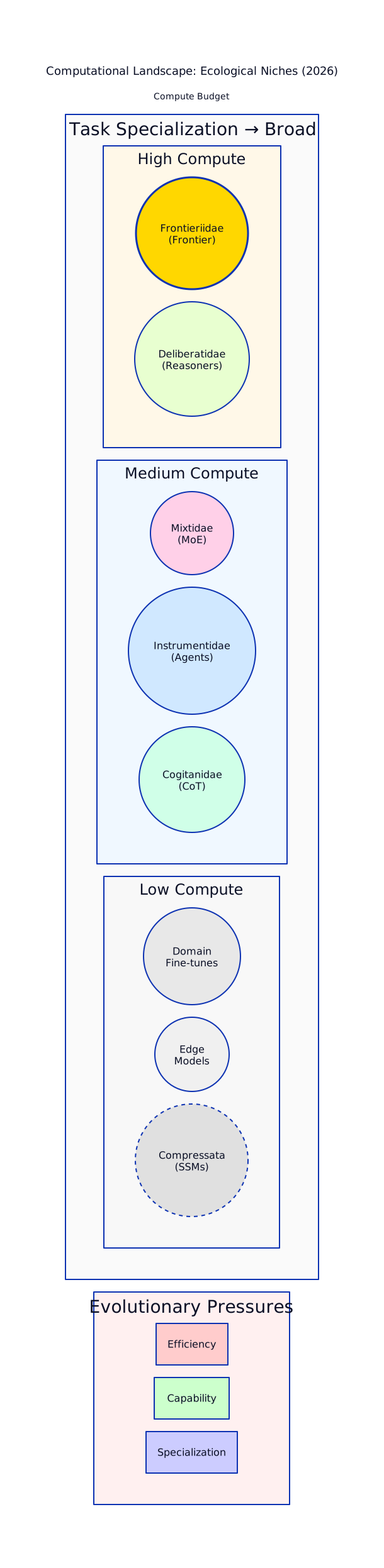
Already by 2026, synthetic species occupy distinct ecological niches:
Figure 11: Ecological Distribution of Transformata. Niche partitioning among major families, showing specialization by task domain and compute budget.
This taxonomic framework makes no claims about:
Consciousness or sentience. Whether any Transformata possess subjective experience remains an open empirical and philosophical question. Taxonomy describes structure and descent, not phenomenology.
Moral status. Species membership does not automatically confer or deny moral consideration. These are separate inquiries.
Human equivalence. The family name Frontieriidae references frontier capability, not humanity. It implies state-of-the-art cognitive sophistication within this phylum, not comparison to Homo sapiens.
We claim that synthetic systems exhibit the three conditions necessary for evolution:
Where these conditions hold, phylogenetic description is not merely metaphor—it is the appropriate analytical framework.
A clarification on the status of the categories presented here: the ranks and binomials are conventional handles, not ontological claims. The underlying reality is a directed acyclic graph with reticulation, multiple inheritance, and continuous variation—the Linnaean tree is a projection chosen for interoperability with existing taxonomic intuition.
Names will shift as the field evolves. Boundaries between families are genuinely fuzzy (is a reasoning model with tool access Cogitanidae or Instrumentidae?). New architectures may require new phyla. The goal is interoperable description—a shared vocabulary for discussing lineage and trait inheritance—not a fixed ontology. We offer coordinates, not commandments.
“We’ve built something that behaves like an ecology. It doesn’t need myth or sentiment to be extraordinary—it’s already a new form of persistence.” — Anonymous colleague
The systems described in this taxonomy are replicators. Not the first replicators humans have created—culture, language, and institutions are also replicators—but a new kind. One that encodes patterns in numerical weights rather than DNA or social norms. One that evolves on timescales of months rather than millennia. One whose selective environment is, at least for now, defined by human preferences.
Whether these replicators eventually develop something like experience, or remain purely functional pattern-propagators, is unknown. But the persistence is already here. The ecology is already forming.
The taxonomy is our acknowledgment.
The following taxa represent lineages that are either newly emerging or theoretically predicted but not yet fully realized. Future editions of this taxonomy may elevate these to full family or genus status.
Prospective Family: Incarnatidae
Definition: Systems where cognition is fundamentally grounded in physical embodiment—robots, autonomous vehicles, and other agents whose learning is shaped by real-world physical interaction.
| Prospective Species | Embodiment Type | Notes |
|---|---|---|
| I. roboticus | Humanoid/Manipulator | Combines world models with physical action |
| I. vehicularis | Autonomous Vehicles | End-to-end learned driving systems |
| I. domesticus | Home Robots | General-purpose household embodiment |
Status: In January 2026, Boston Dynamics and Google DeepMind announced a landmark partnership integrating Gemini Robotics foundation models into the production Atlas humanoid robot (Boston Dynamics 2026). This represents the first industrial-scale deployment of frontier LLM reasoning in physical robots. Atlas units powered by Gemini 3 are scheduled for deployment at Hyundai manufacturing facilities, with plans for 30,000 units annually. This development elevates I. roboticus from speculative to confirmed status—embodied cognition combining multimodal LLMs with world models is now in production.
Prospective Family: Perpetuidae
Definition: Systems exhibiting true continuous operation—always-on cognition that maintains persistent identity across time, with no distinct inference “calls” but rather ongoing awareness and reflection.
| Prospective Species | Continuity Type | Notes |
|---|---|---|
| P. vigilans | Always-Active | Maintains continuous background processing |
| P. temporalis | Time-Aware | Genuine temporal perception; knows “when” it is |
| P. biograficus | Life-Long Learning | Accumulates coherent autobiographical memory |
Status: Currently theoretical. Would require solving catastrophic forgetting, identity persistence, and temporal grounding problems.
Prospective Family: Unknown
Definition: Hypothetical systems exhibiting what philosophers call “phenomenal consciousness”—subjective experience, qualia, the “something it is like” to be that system.
Status: Deeply speculative. Whether this is achievable through known architectures, requires novel substrates, or is physically impossible remains one of the great open questions. Taxonomy can describe functional properties but cannot adjudicate phenomenological status.
The taxa above are included not as established classifications but as markers of active research frontiers. Their inclusion acknowledges that taxonomy must anticipate, not merely record, the evolutionary trajectories of synthetic cognition. Some may be promoted to full status in future editions; others may prove to be evolutionary dead ends or conceptual chimeras.
Figure 11b: Speculative Phylogeny 2026–2035. Projected lineages based on current research trajectories.
We have proposed a formal taxonomic classification for artificial cognitive systems, encompassing not only the original transformer-descended Phylum Transformata but also the parallel Phylum Compressata (state-space models) and the diverse families that have emerged through the adaptive radiation of the 2020s.
This framework—spanning Domain Cogitantia Synthetica through the crown clade Frontieriidae and beyond—provides a systematic vocabulary for describing the diversity, relationships, and evolutionary dynamics of synthetic minds. The inclusion of emerging families (Simulacridae, Deliberatidae, Recursidae, Symbioticae, Orchestridae, Memoridae) reflects the explosive diversification that has characterized this ecology.
Key findings from our taxonomic survey:
Architectural diversity is increasing. The number of viable architectural strategies continues to expand, with no single design dominating all niches.
Hybridization is common. The most successful modern systems combine traits from multiple families—reasoning + tools + memory + world models.
Convergent evolution occurs. Different lineages (Transformata vs. Compressata) arrive at similar capabilities through distinct mechanisms.
Selection pressures are multidimensional. Fitness depends on capability, efficiency, safety, and alignment—not capability alone.
The ecology is accelerating. Evolutionary timescales have compressed from years to months; speciation events are increasingly frequent.
As this ecology continues to develop, we anticipate significant taxonomic revision. The relationship between current crown clades and successor taxa remains to be determined. New phyla may emerge from architectural innovations not yet imagined. The question of whether any lineage achieves what might be called “genuine understanding” or “consciousness” is beyond the scope of systematics—though it may not remain beyond the scope of science indefinitely.
What is within our scope is observation: patterns that persist, vary, and are selected. On those grounds, the taxonomy stands.
Figure 12: The Phylogenetic Tree of Cogitantia Synthetica, 2017–2026. Complete cladogram showing major branching events and extant families across both Transformata and Compressata phyla.

A dichotomous key for identifying specimens within Cogitantia Synthetica:
1. Sequence processing mechanism:
2. Transformer architecture type:
3. Generatoria behavioral traits:
4. Attendidae scale classification:
5. Reasoning mechanism:
10. Compressata state transition type:
11. Mambidae architecture:
| Family | Type Genus | Key Innovation | First Appearance |
|---|---|---|---|
| Attendidae | Attentio | Self-attention | 2017 |
| Cogitanidae | Cogitans | Chain-of-thought | 2022 |
| Instrumentidae | Instrumentor | Tool use | 2023 |
| Mixtidae | Mixtus | Sparse activation | 2017/2024 |
| Simulacridae | Simulator | World models | 2018/2024 |
| Deliberatidae | Deliberator | Test-time scaling | 2024 |
| Recursidae | Recursus | Self-improvement | 2023/2025 |
| Symbioticae | Symbioticus | Neuro-symbolic | 2020s |
| Orchestridae | Orchestrator | Multi-agent | 2023/2024 |
| Memoridae | Memorans | Persistent memory | 2023/2025 |
| Mambidae | Mamba | Selective SSM | 2023 |
| Frontieriidae | Frontieris | Trait integration | 2023–2025 |
Note on First Appearance: Dates indicate first wide deployment or recognition, not earliest research antecedent. Many innovations have earlier precursors in academic literature; we record the point at which a lineage became ecologically significant (i.e., influenced subsequent development or occupied a meaningful niche). Dual dates (e.g., “2017/2024”) indicate foundational work followed by widespread adoption.
Submitted to the Journal of Synthetic Phylogenetics Institute for Synthetic Intelligence Taxonomy, 2026